
Forest Park is someplace St. Louis likes to brag about.
“It’s bigger than Central Park!” goes a common refrain. “There’s so much to do, and almost all of it is free!”
This is true: from the Dwight Davis Tennis Center to the St. Louis Art Museum, from the two golf courses to the Missouri History Museum, and from the St. Louis Zoo to the myriad trails, green spaces, and athletic fields, it’s easy to see why Forest Park is often called St. Louis’s “Crown Jewel.” Site of the 1904 World’s Fair and Olympic Games, the park’s 1,371 acres easily outpaces Central Park’s 843. And with so many amenities, it’s no wonder so many residents are proud and visitors are impressed.

That is until you stop focusing on what’s in the park, and notice what isn’t.
When I moved to St. Louis 15 years ago, back when Barack Obama was just a Senator from Illinois and my beloved Seattle Supersonics still existed, I was excited to use the park at every opportunity. But I quickly discovered one way in which I couldn’t use it.
To play basketball.
That’s right, despite sporting facilities designed for use in pursuits as various as archery, baseball, softball, cricket, golf, handball, racquetball, ice skating, rugby, football, soccer, tennis, pickleball, paddle boating, canoeing, and kayaking, there is nary a basketball hoop to be found. Not in 2006, not in 2021, not (as I have come to find out) ever.
Needless to say, I found this deeply strange, and potentially problematic. Fifteen years later, having come to both love and dislike many things about my adopted home, I don’t find it strange at all, but it is all-too-predictably problematic.
The problem, as you might guess, is systemic racism, along with its right hand in city planning: redlining. In St. Louis, this race-based residential division is known as the “Delmar Divide,” for the street, Delmar Boulevard, which functions as the dividing line. Though of course redlining is no longer actively practiced, a demographic map of St. Louis starkly demonstrates the continuing reality: the area north of Delmar is almost exclusively inhabited by Black people, while the area south of it is mostly white.
Forest Park is located south of Delmar, but it is open to all St. Louisans, and Black people do use the park. But ask Black park users why there are no basketball facilities in the park, as I have, and the reason is crystal clear to them: the powers that be do not want large groups of Black people, and young Black men in particular, hanging out in the park. Though people of all races and ethnicities play basketball, of course, the sport’s association with outstanding Black athletes at the collegiate and NBA levels has led to the game becoming a cultural marker of Blackness. Hence the notion: build hoops, and Black people will come.
As one of the last aspects of public life that is shared across the increasingly fractious American political spectrum, sports make visible many of the social inequities and forms of discrimination (along the lines of race, class, gender, and sexuality) that many privileged people would prefer to ignore or discount. Insofar as basketball would function similarly in Forest Park, the park’s power brokers have clearly preferred to render the game invisible.
As a Sports Studies scholar who teaches and conducts research on race in sports, I’ve often wondered what I could do to address this glaring absence and its racist implications—especially in the wake of the murder of Michael Brown and all that took place in the Ferguson, just 10 miles north of Forest Park. Sure, I could write about it, as I am doing here at long last, but that somehow seemed insufficient. As an anti-racist ally, I wanted to do something about it, not just point it out to other white people.
Fortunately, I found a collaborator, John Early, who is not only similarly inclined, but also is an artist with a vision for creatively communicating the problem to an audience beyond academia, including the powers that be. Together, we have created Whereas Hoops, a multimedia project that tells the story of basketball in Forest Park and St. Louis at large, and attempts to make visible all the power lines (race, class, gender) that connect them. The name “Whereas Hoops” is inspired by the language of St. Louis Aldermanic board bills, two of which have been introduced in the last five years proposing to install basketball facilities in Forest Park: both died mysteriously in committee. The scope of our research also extends beyond Forest Park to include the larger frame of St. Louis, a city that hasn’t hosted an NBA team in 55 years. Despite that absence, the city has a rich history of hoops excellence at the professional and collegiate levels, and a thriving prep scene that produced 2021 Olympic Gold Medalists Jayson Tatum and Napheesa Collier.
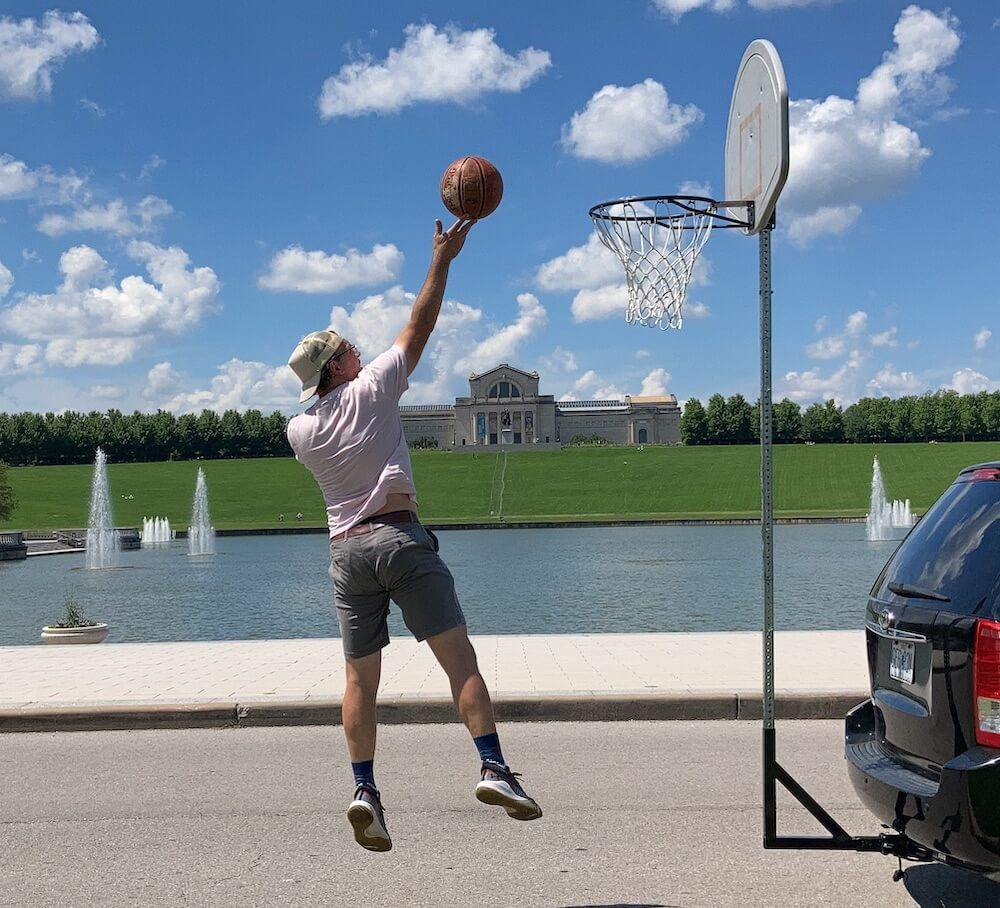
While we initially shared our research primarily on Instagram (though we also have a website, Facebook page, and Twitter account), we have since expanded our efforts to include outreach to local parks officials and elected representatives. We also make regular forays into the park to connect with St. Louisans and ask them: Why aren’t there basketball facilities here, when there are so many other sporting amenities? What does that say about who is and isn’t welcome in the park? We have also constructed our own mobile hoop, which we regularly bring to the park to show people that hoops would be a natural fit in St. Louis’s “Crown Jewel.” As far as anyone can tell, our first mobile hoop exhibition on June 5, 2021 marked the first time anyone played basketball in Forest Park in its 145-year history.
Our ultimate goal is to make an impact on the built environment of Forest Park: to garner enough support to make basketball hoops a welcoming presence, rather than glaring absence, in the park landscape. To do that, we’ll need to gather the support of city and park officials, as well as plenty of ordinary St. Louisans: a task that will take time and plenty of concentrated effort.
It won’t be easy, but I am hopeful. After all, it was just four years ago that a Confederate Monument, a racist presence in Forest Park for 103 years, was removed thanks to the efforts of local activists. Not only that, but the road leading to the monument, “Confederate Drive,” was ripped up and replaced with grass. The absence of basketball courts is not an equivalent offense to a monument overtly celebrating the white supremacist “Lost Cause,” but it is, I would argue, a kind of echo of that sentiment: a reminder that many white people still prefer spaces where people of color, if not kept entirely absent, are represented only as a small minority.
It’s time to change that attitude, to show St. Louisans that we will all benefit when Forest Park is a more welcoming and equitable place for all. Then the park will be someplace to brag about, and play hoops in.